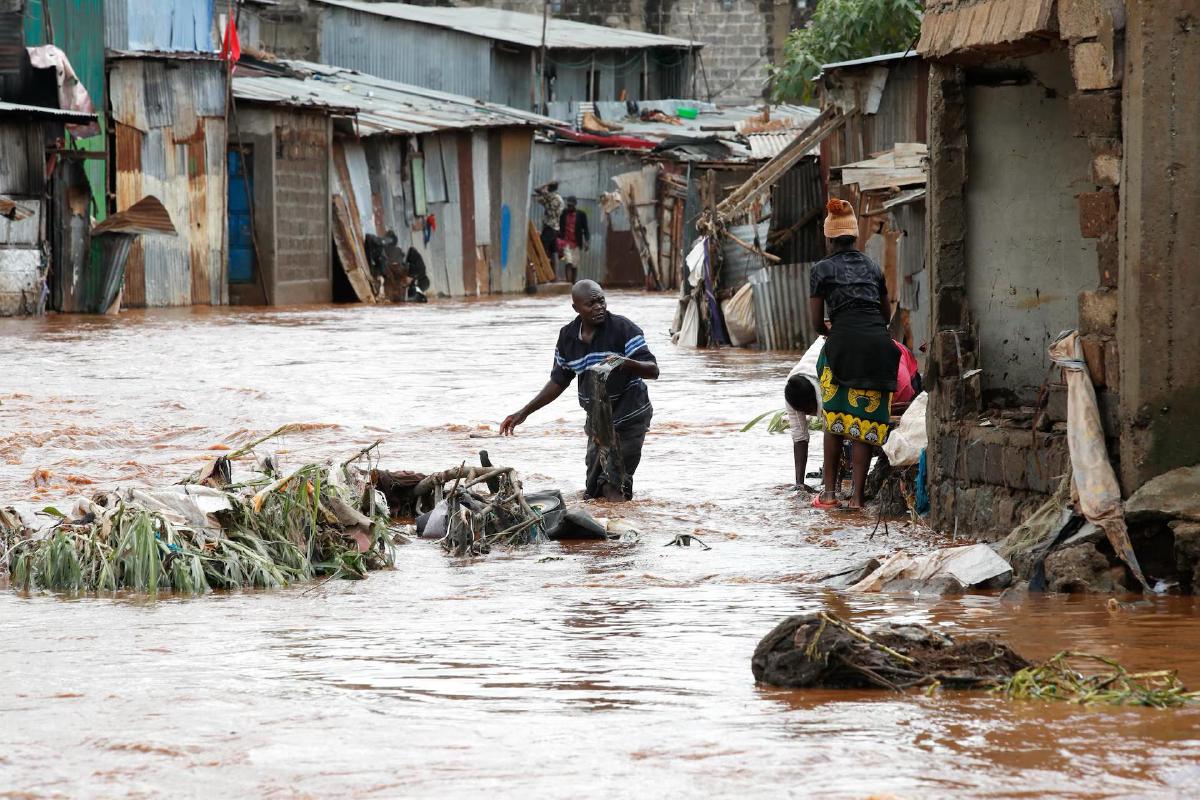
On the evening of Friday, March 6, the same desperate calculation played out in home after home across Mukuru kwa Njenga, Mathare, Kibera, and Pipeline — Nairobi’s densest, most flood-prone neighbourhoods: what could be saved, and what had already been lost.
By morning, twenty-three people were dead. Hundreds of vehicles had been swallowed by roads that double as rivers every rainy season. Kenya Airways diverted flights to Mombasa. The military was deployed. A city of five million had, once again, been brought to its knees by rain.
This is not a story about an extreme weather event. It is a story about a city that knows exactly what is coming — and chooses, year after year, to do very little about it.
The Forecast Was Never the Problem
The Kenya Meteorological Department had issued warnings days before the rains hit. The long rains arrive in Nairobi between March and May every single year. Flood-prone neighbourhoods have been mapped. Vulnerable communities are known. The season is not a surprise.
And yet the official response arrived, once again, after the damage — with emergency deployments, ministerial statements, and urgent action that would have been far more useful three months earlier, before a single drop had fallen.
In 2024, flooding killed 294 people across Kenya, with an estimated 256,000 affected in Nairobi County alone. Communities rebuilt. Relief organisations moved in. Reports were filed. When the skies cleared, so did the urgency.
The preparation for this season was much the same as the preparation for the last one.
A Renewable Political Promise
Nairobi’s drainage system was designed for a colonial-era town a fraction of its current size. Today the city holds well over four million people, many of them in dense informal settlements built along riverbanks and in low-lying areas that formal planning long ignored. The Nairobi River — running brown and choked with plastic through the heart of the city — barely functions as a waterway. When heavy rain falls, Nairobi has nowhere to put the water.
This is not new information. Engineers know it. City planners know it. Residents living beside blocked drainage channels have known it for longer than most officials have held office.
What has been missing is not knowledge of what needs to be done. It is the political will to do it — and the reason for that absence is worth stating plainly.
Fixing Nairobi’s drainage has been a campaign promise in nearly every election cycle for the past two decades. It appears in party manifestos. It is announced at rallies held in the very neighbourhoods that flood worst, where the need is most visible and the votes most needed. Budgets are cited. Groundbreaking photographs are taken.
Then the election passes. The rains return. The drainage, somehow, is still broken.
This is not ordinary incompetence. Incompetence this reliable has a logic to it. The promise of fixing a problem is only politically useful for as long as the problem exists. A repaired drain cannot be promised again. The flood, understood this way, is not simply a failure of infrastructure. It is a renewable political resource — one that functions precisely because it is never resolved.
Whose Disaster Counts
There is a geography to suffering in Nairobi, and it follows the city’s economic contours almost exactly.
When flooding hits the more visible parts of the city — the highways connecting business districts, the residential areas with national media access — the response is fast. Officials move. Images circulate.
When it hits the informal settlements, the losses are of a different order. Not vehicles, but homes. Not inconvenience, but the small stack of goods bought on credit to sell from a roadside stall, destroyed in a single night. Children pulled from school for weeks. These losses appear in humanitarian situation reports. They do not close airports.
Nairobi’s emergency response has always been calibrated, consciously or not, to where the pressure is loudest. Pressure is loudest where money, infrastructure, and visibility converge. The communities that bear the greatest risk bear it in the quietest part of the city’s attention.
You Cannot Evict Your Way Out of a Housing Crisis
After the 2024 floods, the county government announced plans to relocate residents from riparian zones — the buffer areas along riverbanks where construction is prohibited by law. The legal basis is clear. The safety argument is real. Settlements built on floodplains will flood.
But the announcement skipped the question that makes the whole policy unworkable: where are these residents supposed to go?
The people living along Nairobi’s riverbanks are not there because they are unaware of the danger. They are there because land in safer parts of the city is beyond their reach. Public housing at the required scale does not exist. Affordable housing programmes have waiting lists measured in years. Every safer alternative sits beyond their means.
Clearing a riparian corridor by notice, without first providing somewhere for people to go, does not solve the problem. It moves it — typically into other informal arrangements in other flood-prone areas, farther from people’s livelihoods. The city cannot enforce its way out of a housing crisis.
After the Water Recedes
In the coming days, the pattern will be familiar. Emergency meetings will be convened. Statements will be issued. A task force may be announced. A budget line may be mentioned.
Then the skies will clear. The crisis will slide from the headlines. The county drainage budget will sit in a spreadsheet, waiting for a political moment that never quite arrives. The communities that flooded on Friday will repair what they can, as they always have. Their accumulated knowledge of how to survive a problem the city refuses to solve will not feature in any official strategy.
Next March, the rains will come again.
Do not believe them based on what they say this week, when the bodies are still being counted. Believe them when the drainage is fixed.
Nairobi has survived this before. It will survive it again. But surviving is not the same as learning — and until that changes, the only question is how many more times.