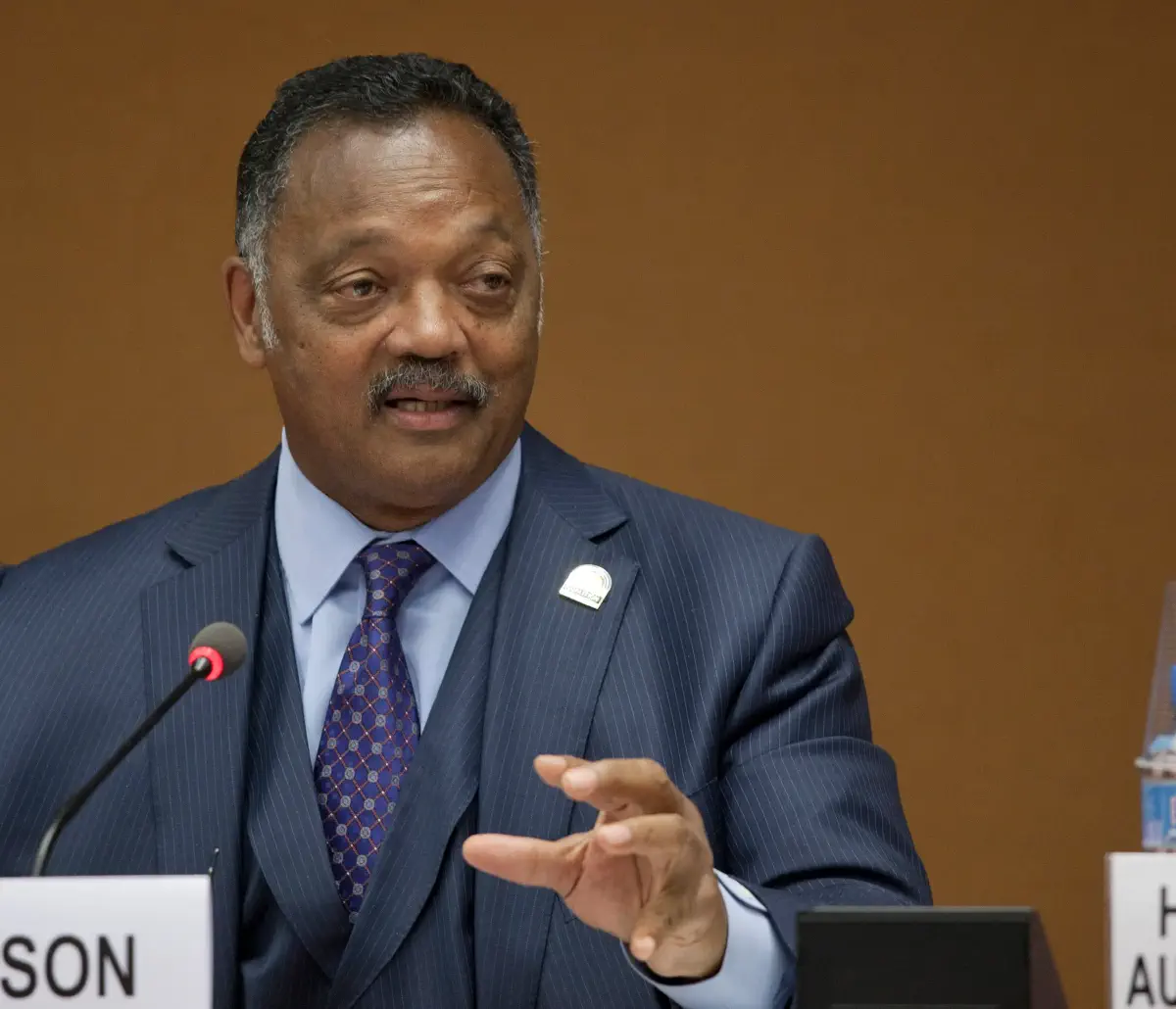
There are people who arrive in the world as if they were sent with a specific assignment. They do not drift through history — they shape it. They do not ask permission to speak — they thunder. Reverend Jesse Louis Jackson was one of those people. Born October 8, 1941, in Greenville, South Carolina, a city that taught him injustice before it taught him anything else, he left this world on February 17, 2026, at the age of 84 — peacefully, surrounded by family, in Chicago, the city he made his pulpit and his battlefield.
The civil rights movement does not have a single face. It has many. But in the decades after the assassination of Dr. Martin Luther King Jr., one face appeared again and again — on picket lines, in presidential debates, in foreign capitals, at factory gates, in jail cells, and in the halls of power. That face belonged to Jesse Jackson. And now it is gone. And the world is quieter for it.
The Preacher Who Ran for President
Jesse Jackson was not supposed to be taken seriously. That was the consensus in 1984 when he announced his first run for the Democratic presidential nomination. He had no major political office. He had no mainstream endorsements. He had only his voice — and it turned out that was enough to terrify an establishment that had long decided who was and was not permitted to dream big.
He ran not as a Black candidate but, as he said himself, “through the eyes of the hurt and the rejected.” He spoke for farm workers and steelworkers, for the uninsured, the undocumented, and the overlooked. He ran again in 1988, this time coming second in the Democratic primary — winning more delegates than any Black candidate in American history to that point. His Rainbow Coalition — an alliance of Black, Latino, Asian-American, White working-class, and LGBTQ voters — was not a political strategy. It was a theological statement. That every person is worthy. That every vote is a prayer.
Barack Obama, who released a statement today calling Jackson “a true giant,” acknowledged what many have long known but rarely said plainly: that his own historic journey to the White House was built, in no small part, on the foundation Jackson had laid. In his two historic runs for president, Jackson laid the foundation for Obama’s own campaign to the highest office of the land. Obama noted that his wife Michelle got her first glimpse of political organizing at the Jackson family’s kitchen table as a teenager. This is not a footnote. This is the whole story. Obama did not emerge from a vacuum. He walked through a door that Jesse Jackson had spent two presidential campaigns prying open with his bare hands.
The Global Freedom Fighter
Jesse Jackson’s moral imagination was never confined to the borders of the United States. He understood, in a way that few American leaders ever have, that justice is not a domestic policy. It is a universal condition.
In 1983, he traveled to Syria and personally negotiated the release of a captured American Navy pilot. He helped free 22 Americans held in Cuba. He went where diplomats would not go and spoke to people that governments had written off. His critics called it grandstanding. History calls it courage.
Nowhere was his international vision more alive than in his relationship with the African continent and its liberation struggles. The name that belongs beside his in this particular chapter of history is Nelson Mandela — the father of a free South Africa, who endured 27 years on Robben Island and walked out not with bitterness but with a blueprint for reconciliation that humbled the world. Jackson and Mandela were kindred spirits — both men shaped by suffering, both men who refused to let suffering have the final word. Jackson was a fierce and vocal opponent of South African apartheid at a time when the Reagan administration was still finding reasons to look the other way. He marched, he protested, he demanded divestment. When Mandela walked free in 1990, it was a victory Jackson had helped to make inevitable.
And then there is Archbishop Desmond Tutu — the other great moral colossus of Southern Africa, whose small stature contained what felt like an ocean of righteous fire. Tutu, who passed from us in December 2021, and Jackson were brothers in the same struggle, separated by an ocean but bound by the same conviction: that God does not make second-class people, and therefore no government has the authority to treat them as such. Jackson and Tutu both understood that the fight against racism was not a fight of Black people alone — it was a fight for the soul of humanity itself. Both men prayed loud. Both men laughed loud. Both men refused to be polite in the face of evil.
A Brother Across the Ocean: Jesse and Raila
There is a particular kind of grief that comes when a man buries his friend, and then follows him into eternity just months later. That is the story of Jesse Jackson and Raila Amolo Odinga.
Raila — Kenya’s eternal opposition leader, pan-Africanist, and democracy’s most stubborn champion — passed away on October 15, 2025, aged 80, in a hospital in India. He had fought all his life. He had been imprisoned, tortured, and defeated at the ballot five times. And still he came back, every time, because men built the way Raila was built do not know how to yield to anything smaller than death itself.
When the news broke, Jesse Jackson did not issue a polished statement through a press office. He spoke from the chest, the way preachers do. “Today, we mourn the passing of my dear friend and brother, His Excellency Raila Amollo Odinga — a freedom fighter, statesman, and tireless champion for democracy and human rights,” his statement read. My dear friend and brother. Those were not diplomatic words. They were the words of a man who had known Raila Odinga up close, who had broken bread with him, who had sat with him in the difficult rooms where history gets made.
And the history they made together is real and documented.
In April 2013, Kenya was a country holding its breath. A bitterly contested election had pitted Uhuru Kenyatta against Raila Odinga. The Supreme Court had upheld Uhuru’s victory, and the two men — fierce rivals who had not spoken since Election Day — were circling each other at a dangerous distance. The country needed them to meet. But pride, suspicion, and the rawness of political defeat stood between them like a wall.
Jesse Jackson flew to Nairobi. Not as a diplomat. Not as an envoy. As a friend. He met with each man separately — speaking to Raila at the home of then-Nairobi Governor Evans Kidero, and to Uhuru through back channels — and did what only a man trusted by both sides could do: he encouraged them to put the election behind them and come together for the sake of Kenya. That Easter Monday, the two rivals shared a dinner table for the first time. Days later, they met at State House. A Kenyan newspaper at the time reported that the influential force bringing them together was Reverend Jesse Jackson. Jackson’s own friends confirmed it quietly: he was the key player.
This was not a man looking in on Africa from the outside. This was a man who had built genuine relationships with African leaders over decades — relationships built on shared struggle, shared theology, and a shared refusal to accept that the powerful had the last word. The South African government recognized this when it awarded Jackson the Companions of O.R. Tambo Award — the highest honour the country bestows on a non-citizen — citing his contribution to the fight against apartheid.
And so when Raila went in October 2025, Jackson grieved as a brother grieves. Now, just four months later, he has followed. There is something almost unbearably fitting about that — two men who spent their lives fighting the same fight, who recognized each other across continents as kin, departing the same year. They are, as Jackson might have said himself, together now in the only constituency that matters.
On this continent — our continent — Jesse Jackson was not a foreign concept. He was a mirror. When he stood at a podium and declared “I am somebody,” those words crossed the Atlantic and landed in townships and slums and villages where people had been told for generations that they were nobody. The Rainbow Coalition had an African spirit in it — the belief that human beings can organise across their differences around the things that matter most. That instinct, that refusal to make the circle smaller than it needs to be, is something African democracy movements have practiced and suffered for in their own ways. Raila lived it. Jackson preached it. They both paid for it.
The Minister Farrakhan and the Complexity of Brotherhood
No tribute to Jesse Jackson can be honest without acknowledging the complex, sometimes controversial world of Black leadership in America — a world where agreement is not always possible, but solidarity runs deeper than politics.
Minister Louis Farrakhan of the Nation of Islam is a figure who provokes strong reactions on every side. He and Jackson have had a long, complicated, often turbulent relationship, forged in the fires of Black American political life. Where Jackson worked within the Democratic Party and appealed to coalition-building, Farrakhan often spoke from a position of sharp, unapologetic Black nationalism. They did not always agree. Sometimes they clashed. But they shared a fundamental conviction that Black people deserved dignity, economic power, and self-determination — and that no one was going to deliver those things without a fight. Jackson’s 1984 campaign was shadowed by Farrakhan’s association with it, creating controversy that Jackson spent years navigating. It was a reminder that the politics of liberation are never clean or simple, that men who want the same destination sometimes disagree violently about the road.
What we can say with confidence is this: both men came from the same soil of Black American suffering. Both men spent their lives, in their different ways, trying to make that suffering mean something. History will reckon with them both. It is not our place to erase the friction — it is our place to understand it as part of the larger, messy, magnificent story of a people fighting for their full humanity.
I Am Somebody
The phrase that defined Jesse Jackson was not delivered in a presidential debate or a foreign capital. It was delivered to ordinary people — to schoolchildren, to prisoners, to welfare recipients, to anyone who had been made to feel small by a world that profits from smallness.
I am somebody.
Three words. Theologically dense. Politically explosive. Personally healing.
He would lead crowds in it like a call-and-response prayer, and something would shift in the room. People who arrived carrying shame would leave carrying something else. That is the ministry of Jesse Jackson in its purest form. It was not about policy or party. It was about the restoration of personhood.
In an era when the language of politics has been reduced to slogans and social media posts, Jackson’s oratory was something ancient and necessary. He injected the cadences of the Black church into American political life — the same church that produced Mandela’s African National Congress meetings, that filled the streets of Nairobi during Kenya’s push for independence, that gave Archbishop Tutu his fire. The church as a site of resistance. The sermon as a weapon of justice.
What He Leaves Behind
Jesse Jackson leaves behind a nation that has not finished the work he started. He leaves behind a Rainbow PUSH Coalition whose name alone is a manifesto. He leaves behind a generation of Black politicians, community organizers, and activists who cut their teeth at his knee. He leaves behind Barack Obama — and through Obama, every young person in Kenya, in South Africa, in Ghana, in Nigeria, in Colombia, in India, who looked at the White House in 2008 and thought: perhaps after all, there is room for me.
He leaves behind the memory of a man who, at 84 years old, still made it to the Edmund Pettus Bridge in Selma, Alabama, in March 2025 — barely a year before his death — to commemorate the 60th anniversary of Bloody Sunday. He was in a wheelchair. He went anyway. That is who he was.
He leaves behind his beloved wife Jacqueline, their children — Santita, Jesse Jr., Jonathan, Yusef, Jacqueline, and Ashley — and grandchildren who carry his name into a future he helped make possible.
The Drum Major Is Gone
Dr. King used to speak about the desire to be a drum major — to lead the parade, to be first, to be recognized. And then he reframed it: what matters is being a drum major for justice. For peace. For righteousness.
Jesse Jackson was that drum major.
He did not always get the credit he deserved. He was too loud for some, too radical for others, too controversial for many. History has a way of being kind to the dead once it has finished being unkind to the living. Whatever his imperfections — and he had them, as all men do — the ledger of his life is unmistakably in the black. The movements he built. The voters he registered. The prisoners he freed. The children he told: you are somebody.
From the banks of the Chicago River to the streets of Soweto. From the debate stages of 1984 to the kitchen table where a young Michelle Robinson got her first lesson in organizing. From the marches of Selma to the presidential campaign of a man named Barack Obama. The thread runs through all of it, and the thread is Jesse Louis Jackson.
The drum major is gone. But the parade he started — for dignity, for justice, for the full humanity of every person on this earth — that parade does not stop.
It keeps moving. Because that is what he taught us to do.
Rest well, Reverend. You more than earned it.
Jesse Louis Jackson | October 8, 1941 — February 17, 2026 | Age 84